Autonomous AI teammate · in production since 2026

Hire the night shift.

Nightshift is an autonomous AI teammate that runs your project operations while your team sleeps. It clears the task queue overnight, keeps your board honest, reviews pull requests, and reports back to your chat before standup.

In production
running a real product team's operations, every night since 2026
05:15 → 07:05
nightly board audit, execution, and morning report on a fixed schedule
19 integrations
wired into the tools your team already uses, not a walled garden
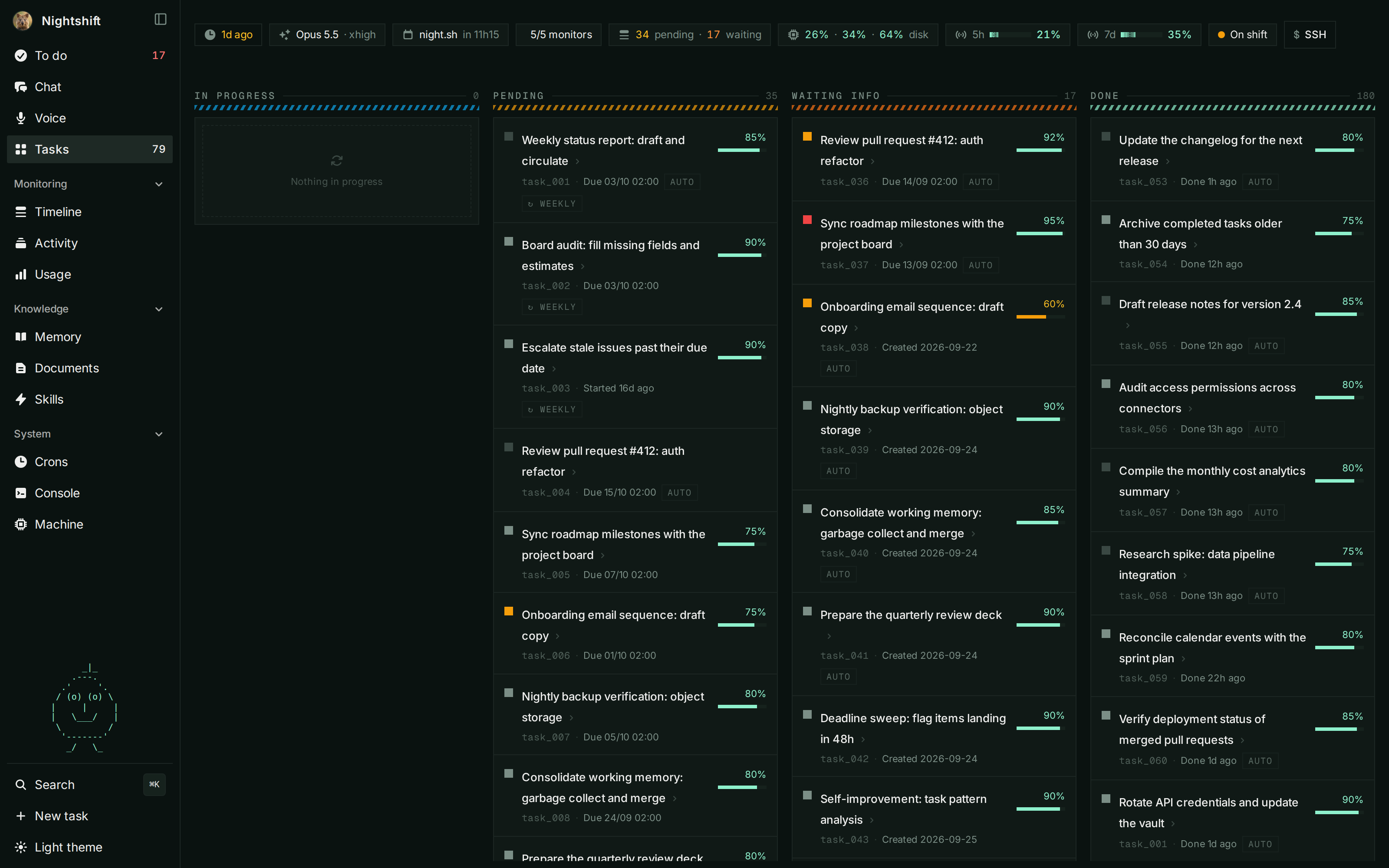
nightshift · task board
Nightshift dashboard: kanban task board with confidence scores and due dates

Small teams drown in project ops.

The board is always stale

Issues without assignees, estimates nobody filled in, deadlines nobody tracked. Someone has to keep the board honest. Usually the founder, usually at midnight.

Context lives everywhere

Decisions in chat, specs in docs, feedback in email, designs in Figma. Every answer costs a search across five tools, and new questions always land on the same two people.

Nothing happens overnight

Work queues up while the team sleeps. Pull requests wait for review, reminders slip, the weekly report gets written late. Again.

Why nothing sticks

You've tried to close this gap.

Every fix so far still leaves the same work on your plate. Here's where each one stops short.

A project management tool
Linear · Jira · Notion

A board only tells the truth if a person keeps it current. These tools track the work; they don't chase missing owners, fill in estimates, or notice what's gone stale. That upkeep is still your job, and it still happens late.

A general AI chat tool
ChatGPT · Claude · Copilot

It answers when you prompt it, then forgets the thread. No lasting memory of your project, no work executed while you sleep, no real reach into your board, repo, or inbox. You still drive every single turn.

A part-time ops hire
Contractor · fractional PM

Expensive, slow to find, and off the clock at night. One person can't audit the board, review pull requests, and write a report before standup, seven days a week, without becoming the bottleneck they were hired to remove.

The mechanism

One night on the job.

The whole product is one loop: a fixed schedule that chases, audits, executes, remembers, and reports. These are real timestamps from the agent's own cron, not a diagram. You go to sleep; it clocks in.

  1. Reminders go out

    Every teammate with something due gets a direct message: two weeks ahead, a week ahead, three days, the day before, on the day. Once it's late, every evening, until the work is done or they tick it off.

  2. You queue a task from chat

    “Draft the weekly status update.” One message in your team chat, or a right-click on any message, context attached. The agent files it and goes back to standby.

  3. Heartbeat: board audit

    It sweeps the project board: fills missing fields, ties every commit from the last 24 hours to an issue, flags what has truly stalled (it checks the code first), and escalates deadlines landing in the next 48 hours.

  4. Execution

    Every queued task whose dependencies are met gets executed, independent tasks in parallel via sub-agents. It first checks the task still makes sense, and when confidence is too low, it writes down numbered questions instead of guessing.

  5. Cleanup

    Working memory is consolidated and context is reset. What it learned tonight is written to persistent memory, not lost with the session.

  6. Morning report

    One message before standup, not ten: what's waiting on you, in a few words, and a link to your to-do list, where every open question has its answers ready to click. The rest of the night is in the dashboard.

Try it

Hand it one night.

Pick something you'd rather not do yourself, then watch the shift run. Each replay is built from a night that actually happened on our own deployment.

nightshift · night run23:42

23:42 · what do you want done before standup?

Scripted replay, not a live agent. Real timings, real events, taken from production logs.

Voice mode

And by day, just talk to it.

Open the dashboard, tap the blob, and speak. Your words appear as you say them, and the answer comes back out loud two or three seconds later.

  • Interrupt it like a person

    Start talking and it stops mid-sentence to listen. A passing cough isn't enough to cut it off.

  • The whole agent behind the voice

    A fast voice agent keeps the conversation going. When something needs checking or doing, it hands the request to the main agent, with every tool and all its memory, and reads you the answer when it lands. The conversation never waits.

  • Nothing happens on a mishearing

    The voice agent itself has no tools, so a misheard sentence can't trigger anything. Anything that goes out or can't be undone is read back to you first.
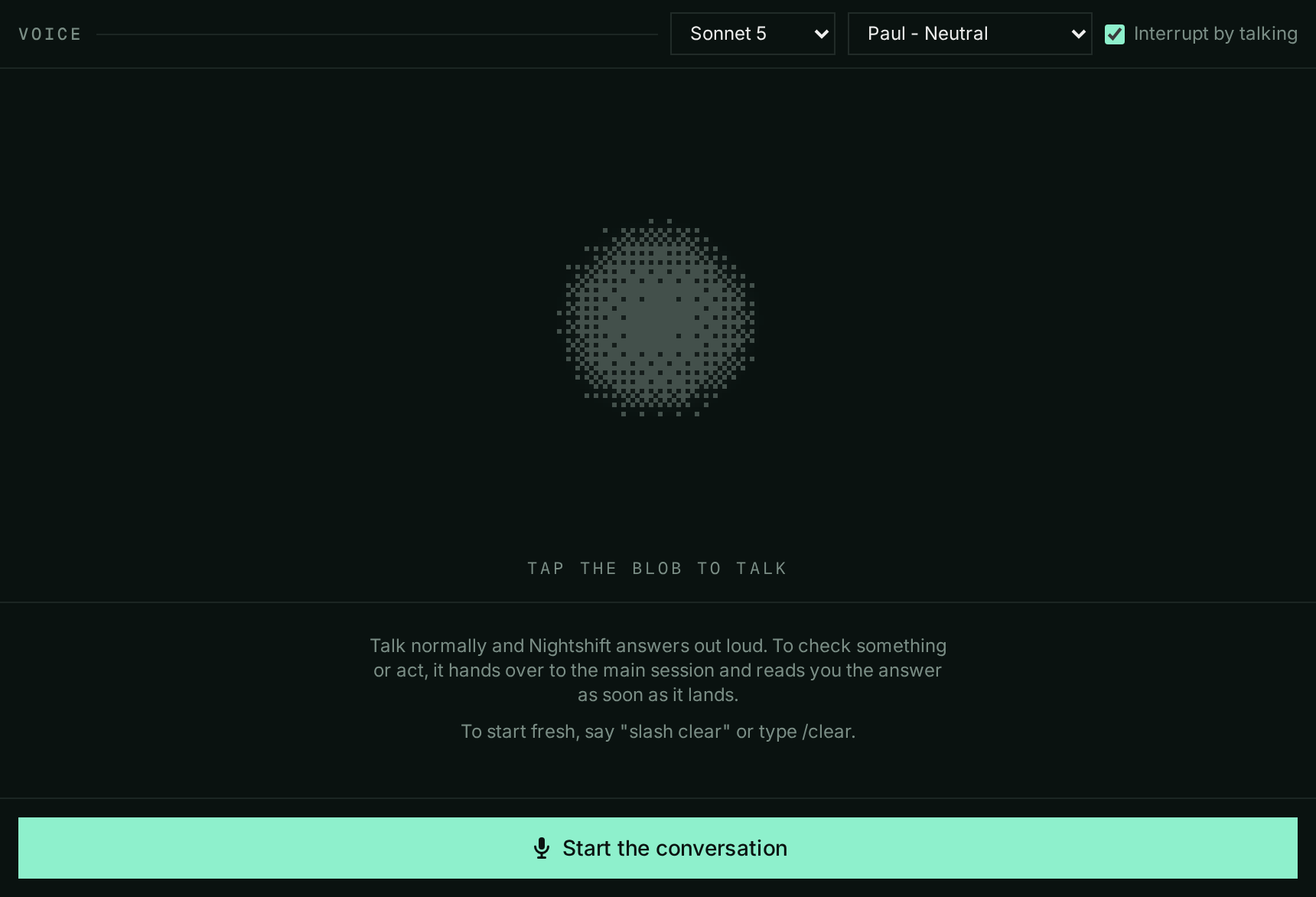
nightshift · voice
Nightshift voice mode at rest: model and voice settings, the blob you tap to start talking, and the start button

Proof, not promises

Straight from the morning reports.

Real entries from a live deployment, anonymized. Nothing staged.

Nightshift07:05 · Tuesday

Overnight: audited the project board, fixed 4 missing fields, and flagged one issue that's been stale for 8 days.

Nightshift19:47 · Wednesday

New pull request opened at 19:32, reviewed 15 minutes later, with two blocking comments and a suggested fix.

Nightshift07:05 · Friday

Expense report deadline in 2 days with no owner. Escalated with a concrete proposal and pinged the responsible teammate.

Everything it does, on the record.

Real screenshots from a production deployment. Click any of them to look closer.

Under the hood

A full teammate, not a chatbot.

The parts that make the nightly loop hold: an autonomous queue that knows what it doesn't know, memory that survives every session, and real reach into your tools.

Autonomous task queue

Queue work in plain language. The agent estimates its own confidence, asks for missing information, and only executes when it's sure.

One-click answers

Every open question lands in one to-do list, sorted by urgency, with its answers ready as buttons. Unsure? Ask the assistant beside it. You can snooze an item, but a hard deadline under 24 hours escalates by direct message anyway.

Persistent memory

Feedback, preferences, and project facts survive every session, linked in a knowledge graph rebuilt every night. Correct it once and the correction sticks. And it searches your whole chat history, not just the last few messages.

Follow-ups that don't let go

Watches deadlines and uptime monitors around the clock, goes over open pull requests every night, and chases people as well as tickets: direct-message reminders until the work is done. What can't wait can also light up a smart display in the office.

Listens to your users

Every night it reads the messages users left in your app, each next to the session that led to it. Bugs get reproduced and filed with proof; small, safe fixes are written that night, with a test that fails on the old code, and wait for your review.

Review pages, not diffs

For each pull request: what changes in plain words, a before/after slider for anything visual, what only you can check, and three verdicts (approve, reject, request changes). Your verdicts become its next instructions.

Real-time dashboard

Kanban, to-do list, heartbeat timeline, live console, cost analytics, side by side if you like. Watch every decision the agent makes and step in from anywhere, typing or talking.

Deep integrations

Discord, Gmail, GitHub, Figma, Google Drive, calendars, email campaigns. The agent works inside the tools your team already uses.

Team-native communication

It answers in your chat, asks numbered questions when blocked, and never marks its own work done. Everything ships through review.

Before you ask

The questions we get first.

Nightshift is a paid product. Pricing is worked out per team: it depends on your stack, how much overnight work you hand it, and the AI usage it runs on. We settle it with you case by case before anything starts. The dashboard shows token spend and cost per session, and before any heavy job the agent checks the budget it has left: it scales down, splits the work, or postpones rather than burning through it.

Start tonight

Put it on tonight's shift.

Tell us your stack and what keeps slipping through the cracks. If Nightshift is a fit, we'll wire it into your project and send you the first morning report.

Get in touchlouislanganay@gmail.com